The European Archaeological Centre

Lien vers votre sélection
Copiez-collez ce lien et envoyez-le par mail

Located in Glux-en-Glenne, a few kilometres from Mount Beuvray, this unique centre in France brings together the skills of researchers and students to advance knowledge of the Bibracte site and Iron Age archaeological research.

A CENTRE FOR ARCHAEOLOGISTS
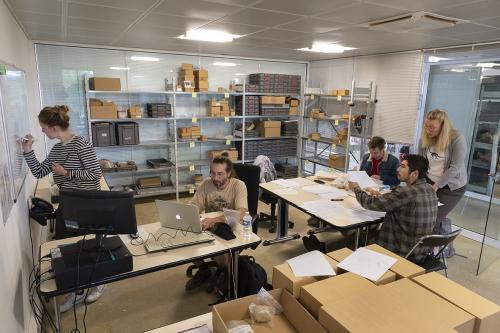
It is a special feature of this centre that it does not have a permanent research team. Here, researchers and students from all over Europe work together to understand the mechanisms of the development of the Celtic town and to discern its organisation. However, an original work site is managed directly by Bibracte archaeologists: the school site, which every summer trains teenagers in the archaeological approach, in real conditions.

The research programme is divided into four-year cycles. The four-year projects are validated by Bibracte's scientific council, made up of eight European experts, before being submitted to the State services for instruction.

Bibracte provides logistical support, stewardship and scientific coordination of research. The centre is equipped with high-performance facilities to support all stages of the research: site equipment, laboratories, documentation centre, conservation areas, publishing chain, etc.

The centre is also the seat of scientific meetings, an essential training centre for students and researchers, as well as a formidable laboratory for experimentation at the service of the archaeological community and heritage professionals. Since 2012, it has also housed the Conservation and Study Centre of the Burgundy-Franche-Comté Regional Archaeology Service, as well as the branches of several preventive archaeology operators.

Bibracte research in figures

. annual excavations since 1984
. a dozen partner universities and research institutes
. about 5,000 working days of associated researchers and students annually
. a permanent support team of a dozen people, including: site manager, machine operators, geomatician, photographer, documentalist, collection manager, conservation manager, editorial unit
. more than thirty volumes published in the collection of scientific monographs edited by Bibracte since 1996, the year the collection was created.

the excavation campaign
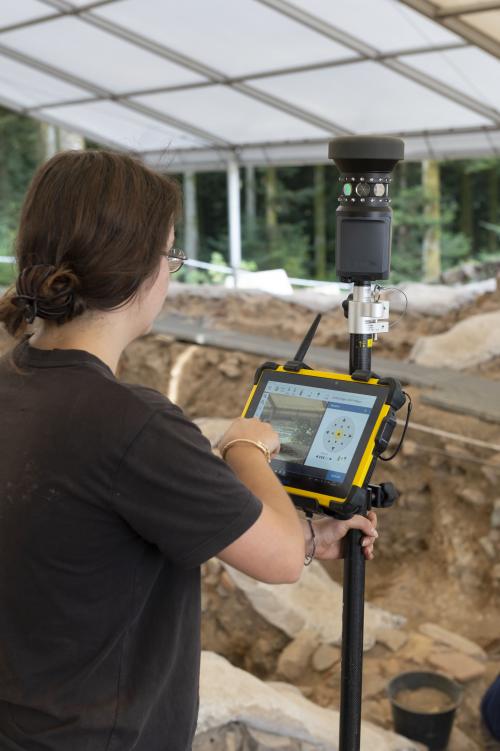
Current research combines excavation operations on the oppidum, geophysical and pedestrian prospecting and specialised studies on the various types of remains and artefacts brought to light. In particular, they are examining the spatial organisation of the town, its urban dynamics, and the material and immaterial flows that irrigate it. Particular attention is paid to paleo-environmental studies.

The results of the annual research campaigns are published online (in french)

In 2021, the excavation campaign includes the following sites:

The Place aux Laides sector
University of Burgundy - ArTeHiS Laboratory, from 29 March to 02 April 2021

The PC14 sector of the Parc aux Chevaux
University of Franche-Comté / Jean Jaurès University (Toulouse) - TRACES Laboratory, from 10 May to 04 June 2021

The Grandes Portes sector
University of Bordeaux Montaigne - Ausonius Laboratory / University of Cluj-Napoca (Romania), from 28 June to 31 July 2021

The PC 2 Roman house in the Parc aux Chevaux
Bibracte school camp for teenagers, from 7 July to 27 August 2021       

Exploratory survey at La Chaume
Masaryk University in Brno and Charles University in Prague (Czech Republic), 26 July to 27 August 2021

Geophysical surveys on Mont Beuvray
Masaryk University of Brno (Czech Republic), from 3 August to 13 August 2021

Documentation centre

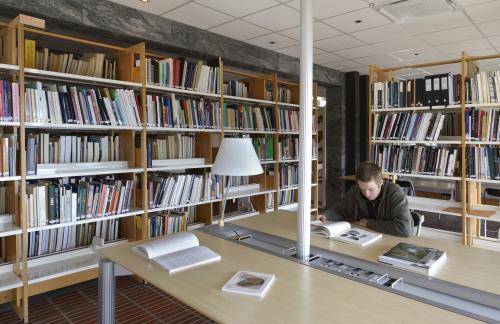
Bibracte has an important documentation centre for European Protohistory.

With more than 20,000 volumes and more than ten archives and thematic documentation collections, all of which can be consulted only on site, this library is one of the most complete in France for this period. It is enriched by approximately 1000 works per year.

The documentation centre is located within the walls of the research centre in Glux-en-Glenne, 4 km from the museum.
It is freely accessible to the public, by appointment, during office hours.
It participates in the Frantiq collective catalogue, which will soon allow remote access to its bibliographic file. 
It offers mini-scholarships to students, in the form of accommodation credits for 5 days per academic year.

For more information, call 03 86 78 69 00 or docu@bibracte.fr

Contact

Archaeologists or students, you can contact the European Archaeological Centre by e-mail or telephone.