Coming with a group of children


A la carte
Guided tour
Workshops
Workshop themes
Stays
Prices
Practical Stays
The team
Bibracte is the ideal place to make young people aware of history, archaeological methods and environmental issues.
A programme made for you
We welcome students from kindergarten to the end of secondary school, with content adapted to their level and to the educational objectives of the teaching team.
Depending on the time you have available, we can offer you a guided tour, a practical workshop, a discovery day or a stay with accommodation.
The activities are accessible independently, but also respond to cross-curricular issues in the field of History, Geography, Life and Earth Sciences, Literature, Arts or Mathematics. These workshops can thus be integrated into the school's objectives and feed into long-term educational projects, depending on the teachers' objectives.
Our team is at your disposal to guide you in setting up your programme. Justine Lemoine is your personal contact at 03 85 86 52 40, resa@bibracte.fr
For more information and to book your visit, please contact Justine Lemoine, in charge of reservations and reception of the public (Monday, Tuesday, Thursday and Friday, from 9am to 5pm):


The discovery visit
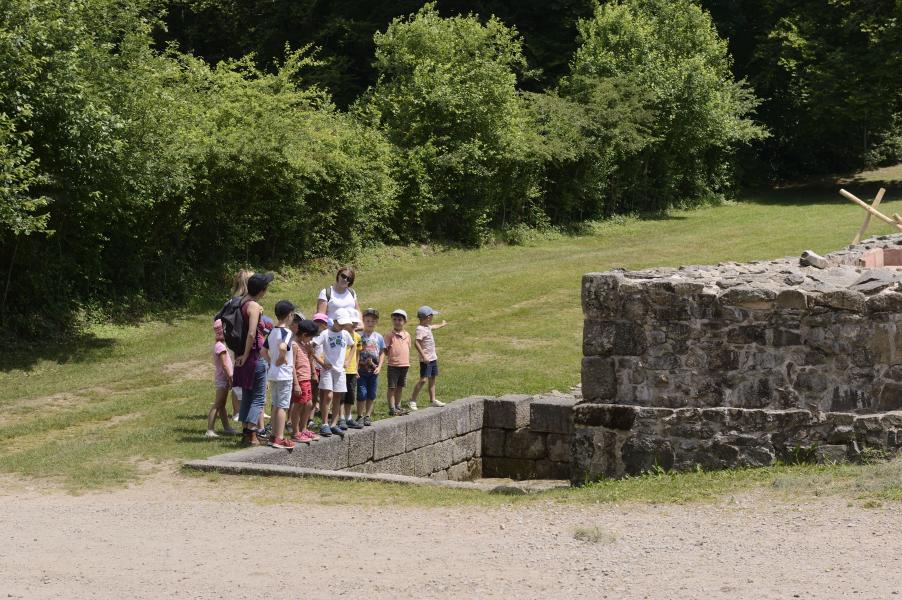
For a global approach to Bibracte, the guided tour of the museum and the archaeological and natural site puts the objects and reconstructions in the museum in relation to the remains of the ancient town, uncovered by archaeologists under the present forest.
The content of the tour is adapted to the age of the participants.
Guided tour of the archaeological site
The guided tour of the archaeological site takes place on Mount Beuvray, in the heart of the ancient Gallic town of Bibracte.
As you explore the various excavation sectors, you will discover the structures that structured the town and the activities that punctuated the daily life of the Gauls. During this visit, our guides will explain the function of the different districts, from the residential areas to the craft district and the "town centre", but also the working methods of the archaeologists and the many questions that are still being asked today.
Duration: 2 hours
Recommended for: cycles 1, 2, 3, 4, secondary school, high school
Subjects covered: Discovering the world / History / Life and Earth Sciences / Mathematics / Literature / Ancient languages / Civic and moral instruction / Experimental and technological sciences
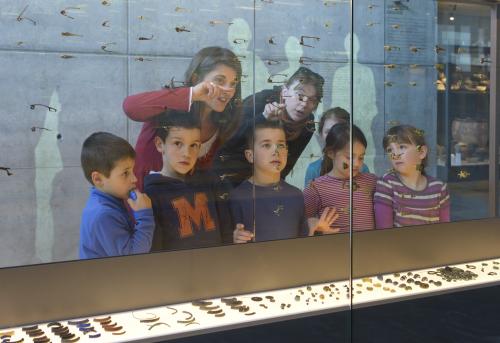
Guided tour of the museum
Duration: 1h30
Recommended for: cycles 1, 2, 3, secondary school, high school, university
Guided tour of the site and the museum
An exhaustive approach to the Bibracte site, focusing on the remains on site, but also on the museum's collections, from excavations at the oppidum or other European sites.
Duration: 3h30 consecutive
Recommended for: cycles 1, 2, 3, 4, secondary school, higher education
Subjects covered: Discovering the world / History / Life and Earth Sciences / Mathematics / Literature / Ancient languages / Civic and moral instruction / Experimental and technological sciences
Additional tip: beware, unlike the "discovery days", this double visit follows a transmission scheme based solely on the guide's speech. For this reason, we do not recommend this formula to younger students.
Activities with a workshop
Would you like to go into more detail on a particular subject or concept? Several thematic workshops can complete your day at Bibracte.
Practical workshop (1/2 day)
These workshops are thematic and each one focuses on a part of the field of knowledge we have on daily life in the Gallic period, archaeological methods, the study and protection of the environment, and the history of the arts.
The description of the different themes proposed in the workshops is available further down on this page.
Duration: 2h30
Recommended for: cycles 1, 2, 3, 4, middle school, high school, higher education (varies according to the workshop)
Our pedagogy: the workshops follow an experimental archaeology approach (understanding the gestures, the stages of manufacture, the use and life of the object). We use an active teaching approach, involving manipulation, information gathering and interaction with our guides.
Materials: some workshops are accompanied by a booklet that serves as a teaching aid during the session. The pupils complete the booklet with information from the museum's collections and discussions with the mediator.
If you would like to take the workshop in hand, either to prepare for your visit or to document a repeat session in class, you can download the "teacher" version of the booklet, including the answers.
Discovery day (1 day)
This formula is the most popular with teachers who want a first approach or a one-day immersion. It consists of a visit to the site and a workshop to be chosen from the selection.
A description of the different themes offered in the workshops is available further down on this page.
Duration: 5 hours, divided between the site visit and the practical workshop
Recommended for: cycles 1, 2, 3, 4, secondary school, high school, higher education (varies according to the workshop)
Materials: some workshops are accompanied by a booklet which serves as a teaching aid during the session. The pupils complete the booklet using information from the museum's collections and discussions with the mediator.
If you would like to take the workshop in hand, either to prepare for your visit or to document a repeat session in class, you can download the "teacher" version of the booklet, including the answers.
Themes of the workshops
A residence for the "jet set"
Archaeology and architecture of a domus, a Gallo-Roman urban residence
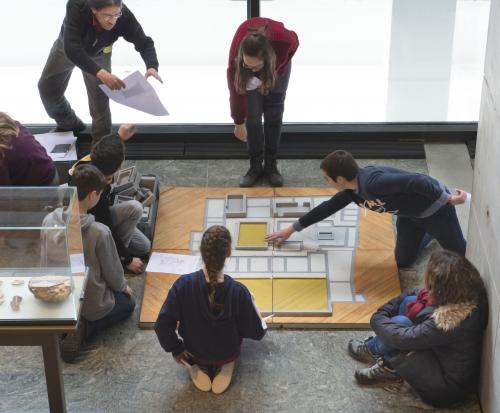
The pupils learn about the organisation of a Roman house: the domus. In the museum rooms, the pupils compare the architecture of a Gallic house with that of the domus. By working on a model and placing the appropriate furniture in it, they identify the function of the different rooms. They then compare the plans of the domus at Bibracte with those of a domus from the same period, but located in the Mediterranean region.
Levels and subjects concerned:
Cycle 2: mathematics, discovering the world
Cycle 3: mathematics, experimental and technological sciences, history, art history
Middle school, high school: history, technology, Latin, mathematics, life science
Fibules and fabrics
How to fasten clothes without buttons?
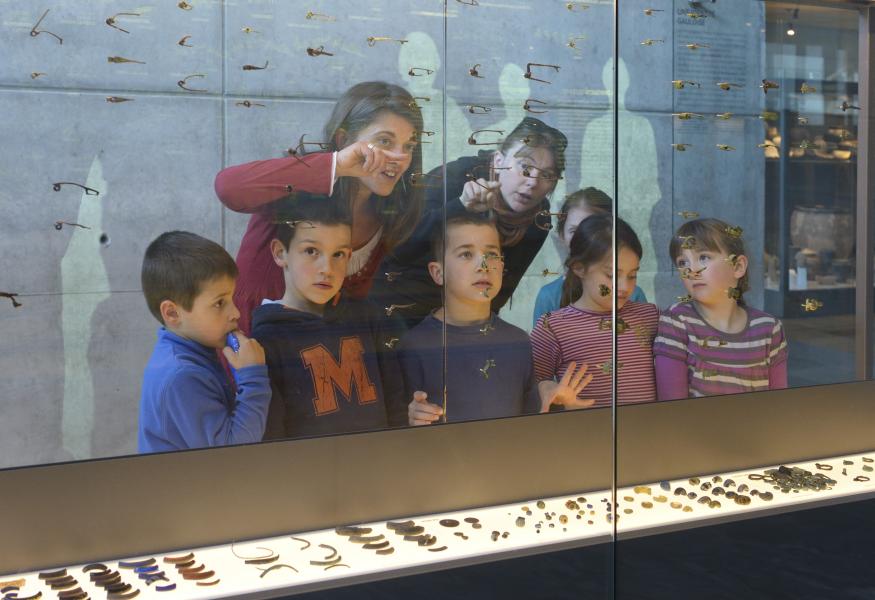
Based on the objects on display in the museum, the pupils carry out an investigation into clothing and objects of adornment among the Gauls, and the archaeological traces left by these activities. Then the fibula - an emblematic object of the ancient periods and a very important chronological marker for archaeologists - is studied through a series of observation games. Finally, Gallic fabrics are studied, including the creation of a "tiny weaving" to understand the manufacturing technique.
Levels and subjects concerned:
Cycle 2: questioning the world, visual arts
Cycle 3: history and geography, visual arts, art history
Cycle 4: history, art history
All our actions leave traces
Investigation of a Gallic dump and a contemporary dump
Initially, based on fictitious current dumps from different years, the pupils are led to identify and partially reconstruct a context of use of various objects. In this way, they follow the evolution of the notion of waste sorting over time.
In a second phase, they carry out a study of a Gallic dump in the museum (excavation at Acy-Romance, Champagne-Ardenne). They identify or hypothesise about the different objects commonly used in the Gallic period.
Levels and subjects concerned:
Cycle 2: discovering the world, civics and ethics
Cycle 3: experimental and technological sciences, history, civics and ethics
Middle school, high school: history, biology, civic education
Grist for the mill
Food in the Gallic period
In the museum, the pupils look for objects related to food and food remains found during the excavations. A summary and classification of the data enables them to define a guideline for the Gauls' way of eating. Then a more specific study of the grinding stone allows them to highlight the material used for its manufacture and its mode of operation.
The workshop ends with the use of a facsimile of a millstone to produce flour, which allows a debate on the efficiency of its use.
Levels and subjects concerned:
Cycle 2: Discover the world
Cycle 3: experimental and technological sciences, history
Middle school, high school: history, technology
Careers in archaeology
Archaeology and its different professions
The pupils are given a list of the various archaeological professions. An initial etymological approach allows them to try to define the terms. These definitions are checked and an explanation of the occupations is given through a series of short films.
Each pupil then chooses a trade and searches the permanent exhibition for all the elements that could be related to it (objects, plans, reconstructions, etc.). They present the results of their research to the group and justify their choice of objects.
Levels and subjects concerned:
Middle school, high school: history, biology, future professional orientation
The "kingdom" of the fragment
Ceramics: from the shard to the pot
Pupils learn about the ceramics on display in the permanent exhibition. They make sketches and identify the role of the ceramics according to the shapes observed.
They then work on shards from the Bibracte excavations (amphorae, beakers, plates, pots) based on the criteria used by archaeologists for sorting and identification and make an archaeological drawing.
Work on clay allows the student to reproduce decorations according to the observations made in the museum. Finally, the workshop ends with the reassembly of a reproduction of a pot or beaker.
Levels and subjects concerned:
Cycle 2: discovering the world, mathematics, artistic practices and art history, visual arts
Cycle 3: mathematics, experimental and technological sciences, history, art history
Middle school, high school: history, art history, technology
In search of the lost recipe
The archaeological approach through the analysis of food
The starting point is a cake, made from ingredients known to the Gauls: the cake is shared and analysed using the five senses (shape, external and internal appearance, consistency, taste, etc.).
The pupils try to guess the various components, then search the museum in small groups for clues relating to the ingredients and their production as well as the culinary utensils (validation of the hypotheses with the help of the seed reference and the permanent exhibition. The information collected is then pooled.
Levels and subjects concerned:
Cycle 2: Discover the world
Cycle 3: experimental and technological sciences, history
Middle school, High school: history, biology, technology
The blacksmith
The blacksmith's gestures
Using an extract from an experimental archaeology video on the exploitation of iron in the Gallic period, the pupils will understand the main stages in the operation of a low furnace.
Then, thanks to a survey in the museum about iron ore, they list the various objects linked to iron working and, after pooling their research, present their observations through drawings or sketches. They then try their hand at hammering a piece of plastiline, using an anvil and a hammer. Once the object is finished, they approach the idea of recycling, by doing the opposite gestures to obtain the slug again.
Levels and subjects concerned:
Cycle 2: Discovering the world
Cycle 3: experimental and technological sciences, history
Middle school, high school: history, technology, life sciences, physical sciences and chemistry
Bibracte under the microscope
A magnifying glass!
The Gauls left traces that mark the landscape on different scales (landscape, relief, construction traces, human agricultural and metallurgical activities, etc.).
It is possible to find microscopic traces in the soil that allow us to collect additional information on this environment and the changes that have occurred over the centuries.
Levels and subjects concerned:
Middle school: biology, history-geography, Latin, physical sciences
High school: physical sciences, chemistry, life sciences, mathematics, Latin, history-geography
High school: science and heritage option
Stays
The discovery class
A three-day project that allows for several workshops and time to visit the site and the museum.
The programme allows you to :
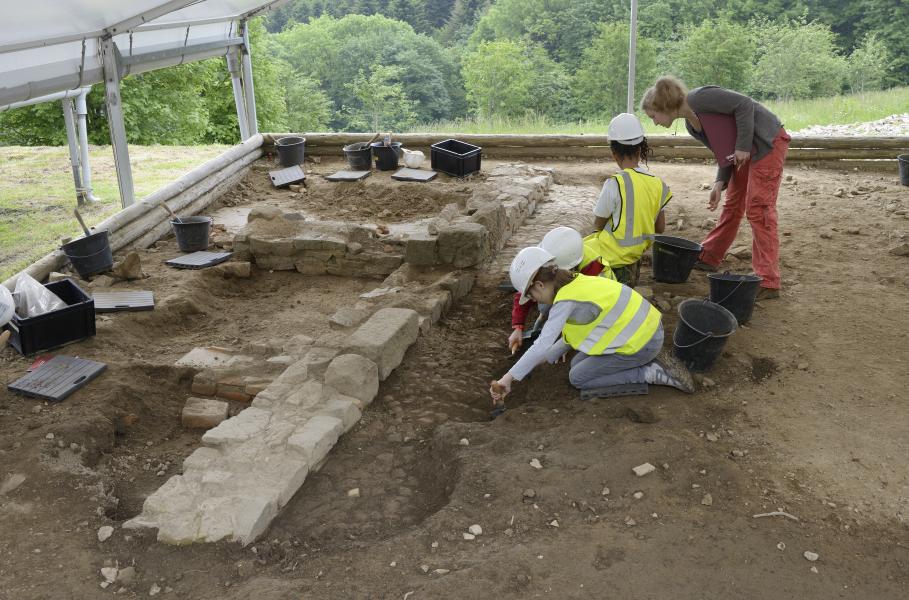
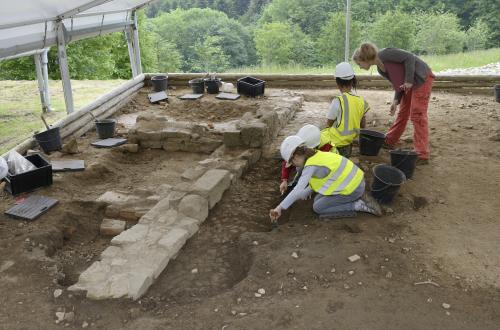
- experiment with archaeological methods (introduction to pedestrian prospecting, excavation and the study of archaeological material) using the Bibracte excavation simulator and the areas of the European archaeological centre,
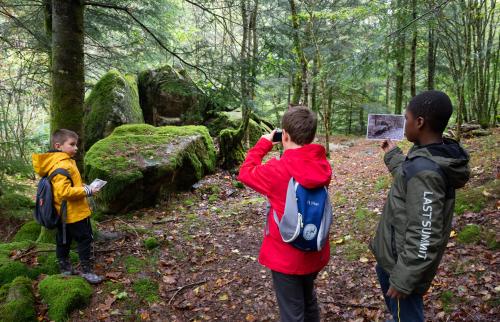
- work on themes linked to the environment (impact of human activities on the landscape since the Gallic period, waste management) by exploring the Bibracte site and the neighbouring site of the Yonne sources and its peat bog.
Each stay is tailor-made, we are at your disposal to develop your projects.
Target groups: cycles 1, 2, 3, middle school, high school
Group size: minimum 10 - maximum 50 pupils (in several groups)
Booking: Information and booking requests should be made to Justine Lemoine on 03 85 86 52 40 or at resa@bibracte.fr
The person in charge of mediation will then contact you to determine the programme that best suits your educational project.
The heritage class
Lasting 4 to 5 days, the heritage class offers pupils and teachers an original experience, by putting together a project combining activities in the museum and in the field.
The class activities are defined according to an educational project, which the teachers have worked on in advance with the Bibracte mediation team.
The programme enables the students to :
- experiment with archaeological methods (introduction to pedestrian prospecting, excavation and the study of archaeological material) using Bibracte's excavation simulator and the areas of the European archaeological centre,
- work on themes linked to the environment (impact of human activities on the landscape since the Gallic period, waste management) by exploring the Bibracte site and the neighbouring site of the Yonne sources and its peat bog,
- understanding the Gallic period through the history of the arts.
Each stay is tailor-made, we are at your disposal for the development of your projects.
Target groups: cycles 1, 2, 3, middle school, high school
Group size: minimum 10 - maximum 50 students (in several groups)
Booking: information and booking requests should be made to Justine Lemoine on 03 85 86 52 40 or at resa@bibracte.fr
The person in charge of mediation will then contact you to determine the programme that best corresponds to your educational project.
RATES AND PRACTICAL INFORMATION
Rates
. Guided tour of the museum (1h30) : 6 € per student
. Guided tour of the site (2h): 6 € per student
. Guided tour of the site and the museum (3h30): 8 € per student
. Practical workshop (2h30): 6.50 € per student
. Discovery day (5h): 12 € per student
. Discovery or heritage class: on quotation
One free adult accompanist for every 15 students.
Foreign language supplement + 15%.
Rates reduced by 20% from the beginning of December to the end of February.
Practical information
A picnic shelter is available near the museum for packed lunches.
We can also offer you a Gallic meal at the restaurant Le Chaudron, at a cost of 12.50 € per student, or picnics.
Please make sure that you are well equipped and well shod, depending on the weather.
Practical conditions of the stays
The accommodation centre
You will be accommodated in the village of Glux-en-Glenne, in the gîte at the bottom of the village. It is a recent building, with 56 beds in 11 rooms (including 15 bunk beds).
The bus drivers are housed in a separate building.
In addition to the accommodation, a room for group activities and a playground are available for the children.
Bed linen is provided, but not towels. There is no street lighting in the gîte, so please bring your own torch. The weather can be very changeable in the Haut-Morvan, whatever the season, so bring warm, waterproof clothing and shoes and socks suitable for walking.
Bibracte's accommodation sites are approved by the Departmental Directorate of Youth and Sports and by the French National Education Authority.
DDJS approval number:
- central gîte: 058 128 124
- gîte du bas du bourg: 058 128 132
Inspection académique approval number:
- gîte central and gîte du bas du bourg: 18 0508
The meals
Meals are taken in the cafeteria of the archaeological centre, located in the centre of the village of Glux-en-Glenne. Menus are prepared on the spot and proposed according to the scheme "starter/ main course/ cheese/ dessert", to be chosen among a selection. We can accommodate special diets if this is specified at the time of booking. As this service is common to all users of the establishment (employees, students, researchers, etc.), we cannot, however, offer à la carte menus.
Places of activity
Visits or workshops can take place on site, at the research centre, at the museum or at the Sources de l'Yonne, depending on the programme established jointly. There are 4 km between the museum and the catering/accommodation site, so it is necessary to provide a means of transport for the various trips.
Please note that during the entire duration of the activities, the children remain under the full responsibility of the teachers and accompanying adults.
THE TEAM
The Bibracte educational team is made up of 3 permanent staff and 18 archaeology, heritage and environmental guides.
Oriane Rousselet, archaeologist in charge of mediation, and Elodie Delhommeau, cultural mediator, design and implement interdisciplinary projects designed to help all audiences discover archaeology, the environment and art history. Justine Lemoine is in charge of reservations and logistics for the trips.
Each year, a teacher is seconded from the French Ministry of Education for 6 hours a week to help design the activities and adapt them to the various school levels.
The Bibracte visitors' service is responsible for the Pôle de ressources pour l'éducation artistique et culturelle (PREAC) dedicated to the archaeological heritage and works with the rectorat, the Direction régionale des affaires culturelles and the Canopé network for creation and educational support to develop and support innovative educational projects and offer annual training courses for teaching and cultural mediation professionals.